Airborne risk associated with PRRS
Research on intake filtration addresses aerosol transmission of PRRSV alongside other biosecurity measures.
Research / source
BSCLEAN · LIVESTOCK BIOSECURITY
Pre-filters, downstream filtration and mounting components for barn intake. Filter selection, custom configurations and project supply.
WHAT AIR FILTRATION TARGETS
Focus on airborne transmission risks associated with PRRS and swine influenza by capturing pathogen-bearing particles and aerosols at the intake.
Air pathway · capture illustration
PRRS-related risk: the animation illustrates carrier particles approaching and being captured by media. Intake filtration complements other biosecurity measures.
Shows captured-particle motion only; not to scale. It does not represent removal of all particles, a specified efficiency or sterile air.
Research on intake filtration addresses aerosol transmission of PRRSV alongside other biosecurity measures.
Research / sourceSwine influenza can involve airborne transmission. Filtration targets airborne particles and aerosols carrying pathogens.
Research / sourceTransmission also involves pigs, people, vehicles, feed and materials. Air filtration addresses the air pathway only and is not a stand-alone ASF guarantee.
Research / sourceBioaerosol sizes vary with source and environment; they are not universally 0.3–1 μm. Verify filter grades, particle efficiency and system performance under their actual test conditions.
FOUR FILTRATION CONFIGURATIONS
From no filtration to pre-filters, staged systems and seasonal modules. Identify the current arrangement before reviewing filter and ventilation requirements.
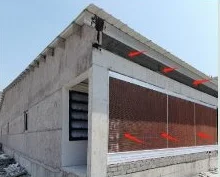 TYPE I
Intake without dedicated filtration
Ventilation introduces outside air without a dedicated intake-filter stage.
Review intake paths, mounting area and retrofit clearance.
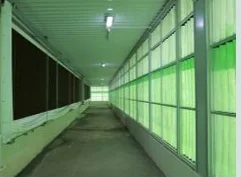 TYPE II
First-stage dust and debris filtration
Provides first-stage protection. A coarse-filter grade alone does not establish control of pathogen-bearing aerosols.
Check downstream stages, media fixing and perimeter seals.
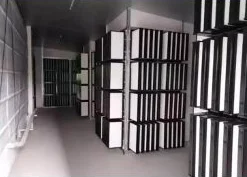 TYPE III
Pre-filter plus downstream stage
Two-stage arrangement in the reference. Confirm particle efficiency, assembly airflow and pressure drop against the actual model report.
Review fan pressure margin, effective filter area and system leakage.
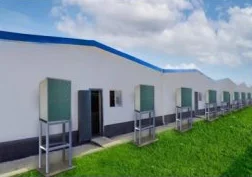 TYPE IV
Staged filtration operated seasonally
Uses pre-filtration and a downstream stage. Coverage depends on operating season, airflow path and module sealing.
Define start/stop procedures, storage and summer design airflow.
| Review point | Unfiltered | G4 only | Two stages | Seasonal module |
|---|---|---|---|---|
| Filter arrangement | No dedicated stage | G4 | G4 + F9 / H10 | G4 + F9 / H10 |
| Primary role | Ventilation only | First-stage particulate removal | Staged particulate removal | Staged filtration while active |
| Key checks | Retrofit space | Downstream requirements | Airflow, pressure drop, seals | Season and bypass paths |
The filter label is not the whole system. Configuration, site airflow, sealing and operating season all matter. The reference’s “about 95%” is not linked to a model and test conditions and is not presented as a universal biosecurity outcome.
Share your site requirementsPIG FARM VENTILATION
Compare fan position and airflow direction to distinguish positive, slight-positive and negative pressure. Seasonal and year-round options describe operating periods for positive-pressure filtration.
Check filter resistance, fan duty point, air distribution and summer airflow.
Blue dashed lines indicate airflow. Rotating blades indicate an operating fan. Curtains, cooling pads and ceiling ducts depend on the project. This is a schematic, not a scaled or measured pressure/airflow simulation.
Positive, slight-positive and negative pressure differ in supply/exhaust arrangement and indoor/outdoor pressure relationship.
Seasonal and year-round describe when filtration runs; they are not fourth and fifth pressure states.
BSCLEAN · FARM SYSTEMS
Reference pp. 13–21: select pre-filtration, final filtration, mounting and supply modules separately. Images show the series; approved drawings define the supplied construction.
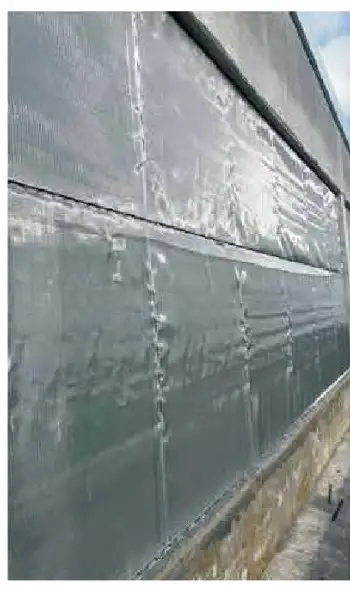
Reference p. 13
For first-stage debris and insect screening. Stainless steel or nylon mesh; stainless steel or aluminum frame. Confirm cleaning instructions for the actual construction.
View product details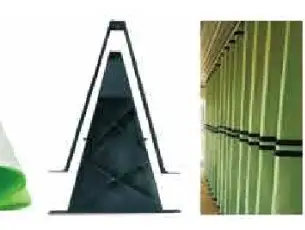
Reference p. 20
Synthetic media on a metal support mesh; plan replacement access, perimeter seals and rainwater drainage.
View product details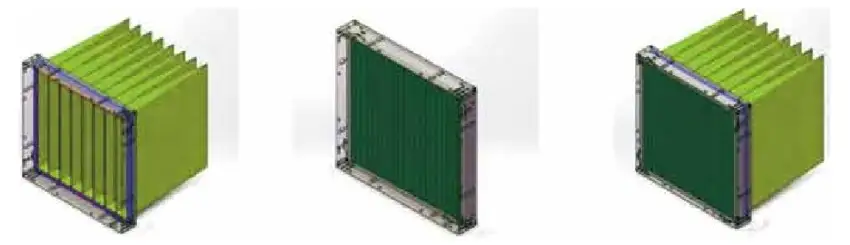
Reference p. 14
The reference shows 20 mm and 45 mm flanges and two-stage mounting, with locating stops, retaining springs and molded seals.
View product details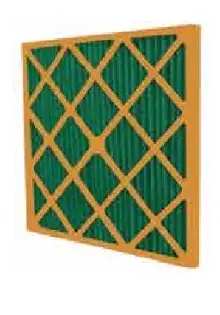
Reference p. 17
Brochure depth options and extended spring clips; confirm mounting clearance and contact with the downstream stage.
View product details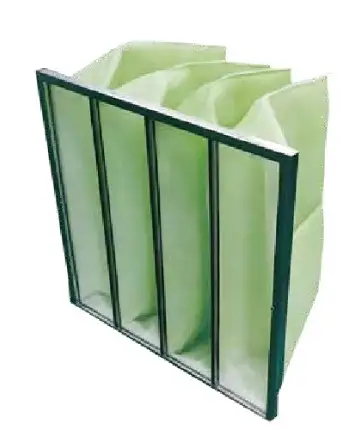
Reference p. 19
Polyester pocket media with welded seams and V-shaped mouth support. Galvanized, aluminum or ABS frame options.
View product details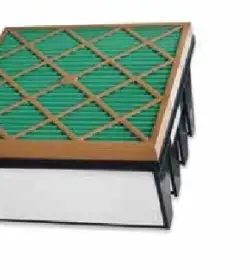
Reference p. 18
610×610×347 mm assembly. Compare total assembly airflow at the stated pressure drop; do not add single-stage performance values.
View product details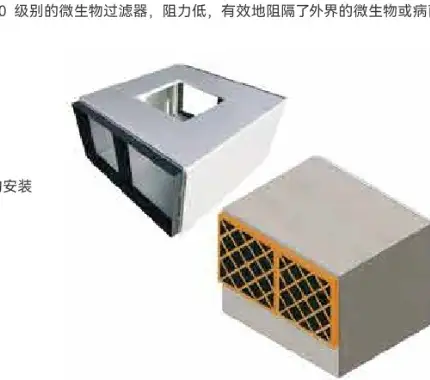
Reference p. 17
Specify for winter ceiling supply, support capacity and service clearance. Airflow depends on filter combination and box construction.
View product details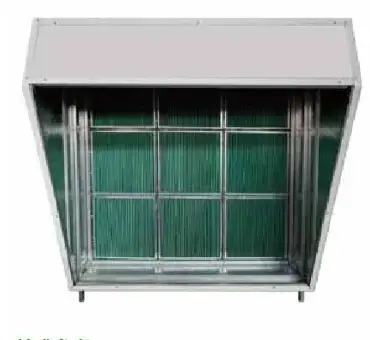
Reference p. 21
BSC-S220, S330 and S340, with aluminum-profile frame, sandwich-panel housing, protective mesh and pressure measurement ports.
View product detailsSlides 13–27 cover humidity, low temperature, dust and chemical exposure. A media name alone does not establish finished-filter performance in a particular environment.
Record humidity, condensation, water ingress and frame condition. Request assembly-level limits.
Confirm minimum temperature, freeze/thaw cycles and inspection requirements.
Track actual airflow, pressure drop and pre-filter condition together.
Slide 27 describes a 24-hour media immersion test, not an on-site disinfection procedure for complete filters.
DOCUMENTATION
Image from slide 29 illustrates the documentation format. Before ordering, request the complete readable report and check model, airflow, method, date and scope. The preview does not certify every model.
Use the project records on this page to discuss new-build, retrofit or equipment scope, and request complete readable test documentation for the actual model.
View company credentials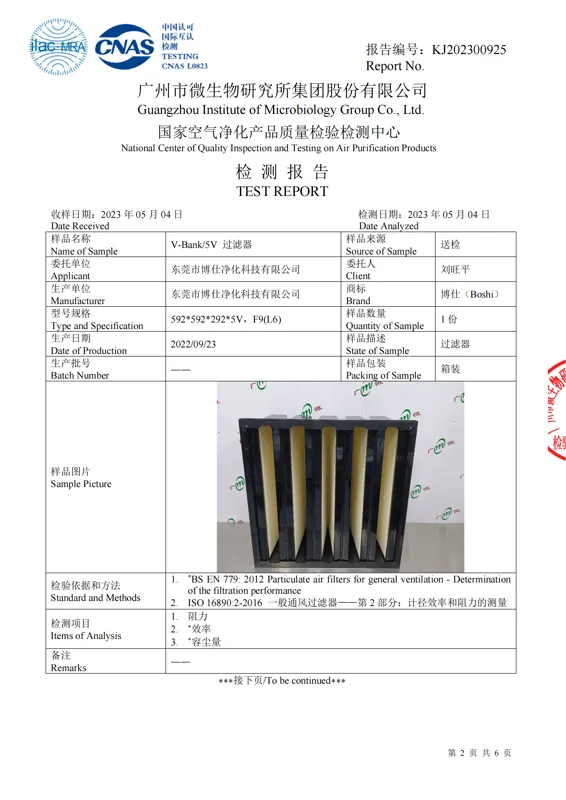 Open report image from the PPT
BSCLEAN · FARM SYSTEMS
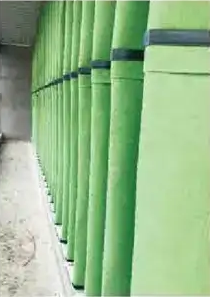
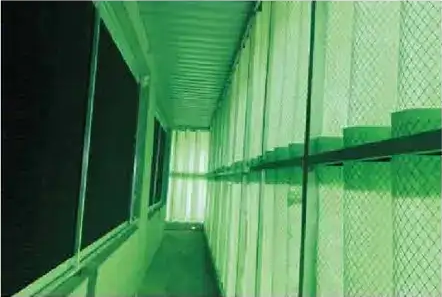
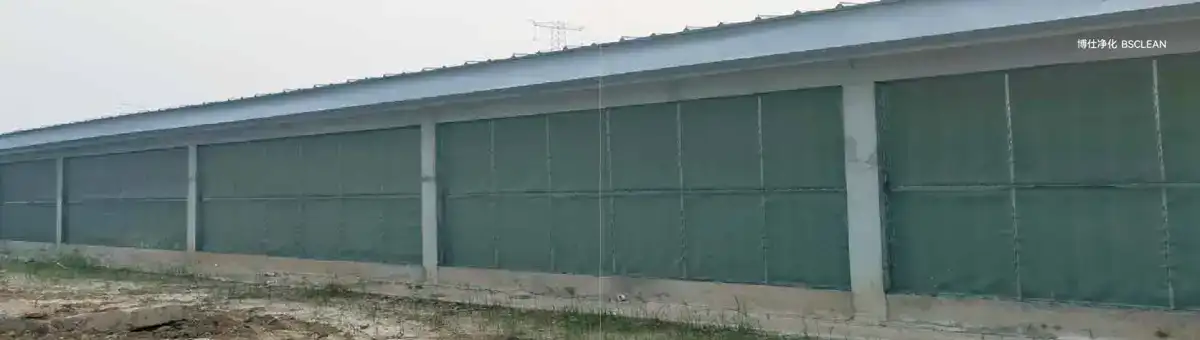
On-site filter walls, filtration corridors and mounting arrays for pig farms.
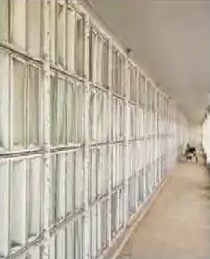
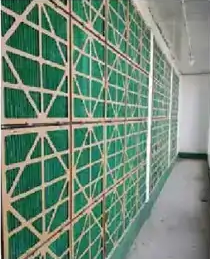
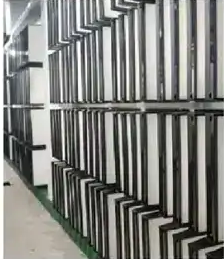
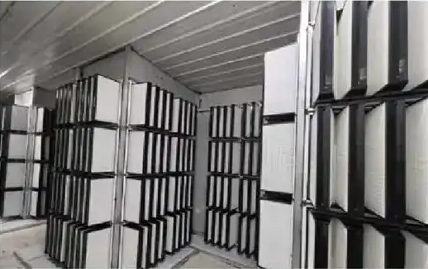
The stages serve different roles. A pre-filter protects downstream filters. Specify MERV 15 against project targets, airflow, resistance and reports.
Review fan duty point, intake paths, installation area and sealing before assessing a retrofit. Adding filters alone is not sufficient.
Check fan curves, stage pressure drops, filter area and measured airflow. Removing the final stage is not a default solution.
The PPT lists 25, 20 and 18 Pa at 1000 m³/h. Also confirm dimensions, construction, reports and quotation before selection.
Inspect media, bonds, frame, airflow and sealing; follow model-specific and project requirements. Appearance alone is not a check.
Review storage conditions, wetting/damage, fixing/seals and airflow/pressure records before restarting under the project procedure.
Follow model and project limits alongside fan capability, actual airflow and integrity. The source does not define one universal month or pressure limit.
Submit design airflow, fan data, mounting dimensions, ventilation arrangement and climate. Quantity is reviewed against the selected filter duty point.
The reference shows a 20 mm plus 45 mm flange assembly. Confirm springs, seal compression, filter geometry and clearance; 70 mm does not fit every pair.
No. The 99% RH field is a humidity specification, not immersion permission. Confirm media, frame and post-cleaning performance.
Not directly. The example uses 0.278 m³/s, 6000 h, 50% efficiency and RMB 0.85/kWh. Recalculate using project data.
The source states 3280 and needs checking against the other model trends. We do not substitute a guessed value; request a confirmed curve.
No. These labels involve different classification systems or editions. Compare the actual report, method, particle range and efficiency.
PROJECT BRIEF
Enter known parameters and mark unknown items “to confirm”. This form prepares an email or a copyable brief; send it through your email application.
Based on the company presentation and additional product reference pages 6–25 supplied by the owner. Values retain slide references and duty conditions. Material comparison figures such as 97.4% and 50% are not published without complete test conditions. Filter selection and airborne-risk controls are not a guarantee against disease.
Panel pre-filter catalog · V-bank catalog