Selection guides
How to Choose Cleanroom Air Filters: H13/H14, FFU and Purchasing
ISO 7 classifies room air cleanliness. H13 and H14 classify filter efficiency. Confirm the installation point, operating airflow and acceptance criteria before specifying the filter class, dimensions and seal.
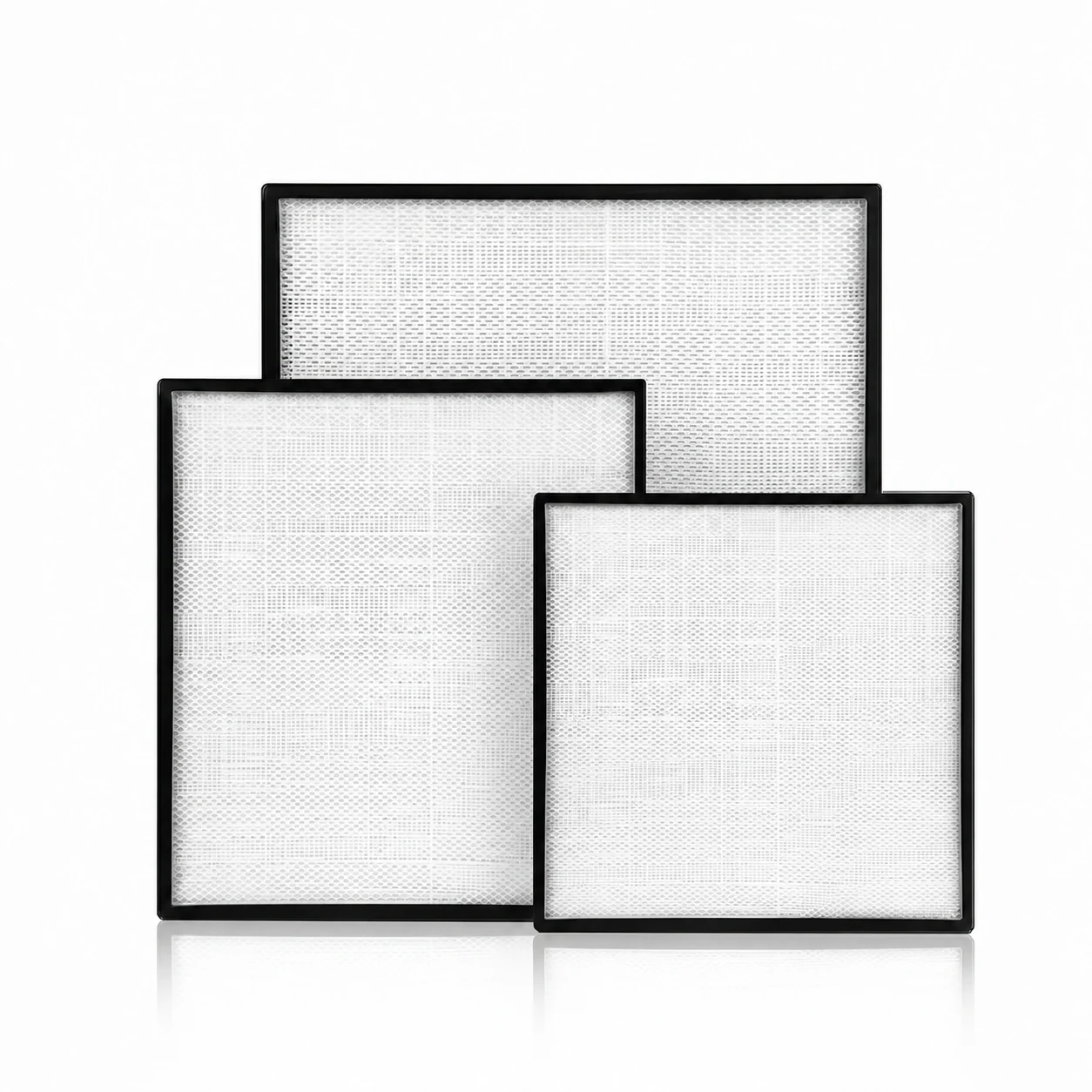
What should you check for each cleanroom application?
| Application | What to confirm before requesting a quote |
|---|---|
| New electronics assembly cleanroom | Confirm the design requirements for the air handling unit (AHU) prefilter and secondary filter, then for the terminal supply filter. Request separate prices for each stage. |
| Aseptic filling line retrofit | Confirm the terminal filter class, sealing arrangement, required factory test records and plans for installed leak testing. |
| Medical device cleanroom expansion | Check process requirements, design airflow and housing interfaces in the new area before reusing the existing specification. |
| Semiconductor packaging or precision assembly workstation | Define the local clean zone, work-surface requirements and supply air layout. Match the replacement filter to the fan filter unit (FFU) model and operating airflow. |
| Lithium-ion battery dry room | Give the supplier the operating dew-point range and other conditions. Ask them to confirm suitability of the media, sealant and gasket. |
| Clean food packaging area | Share washdown frequency, humidity and potential condensation. Ask the supplier to confirm suitability of the media, frame and seals. |
| Conversion of an existing workshop to a cleanroom | Check the available AHU space, operating airflow and fan pressure margin before adding a filter stage or replacing the terminal filters. |
If terminal HEPA filters are due for replacement unusually often, review differential pressure records across each stage, upstream filter condition and installation seals before changing the prefiltration arrangement.
How should you compare H13 and H14, HEPA and ULPA, and supplier quotes?
Request quotes on the same operating airflow, efficiency classification basis and scope of supply. Even when models look similar, pressure drop, sealing interfaces, test charges and delivery terms can change the purchasing decision.
| Comparison | What to check |
|---|---|
| H13 vs. H14 | Start with design and process requirements. If either class is permitted, compare pressure drop at operating airflow, available fan pressure and acceptance criteria. |
| HEPA vs. ULPA | Start with the process particle-control requirements, then confirm that the FFU delivers the required airflow at the filter's pressure drop. |
| Separator vs. separatorless HEPA | Compare available installation depth, pressure drop at the same airflow, service clearance and cost per replacement. |
| Gel seal vs. dry gasket seal | Check the housing interface, sealing surface and retention method. Ask for an assembly drawing before switching seal types. |
| Pocket vs. V-bank secondary filters | At equal filter class and operating airflow, compare pressure drop, installation depth, service clearance and spare filter cost. |
| Glass fiber vs. PTFE media | Request pressure-drop data, operating limits and test documentation for finished filters of the same class. Select based on the actual operating conditions. |
| Domestic vs. imported filters | Compare test records, lead time, spare availability, replacement terms for rejected units and on-site service for the same specification. |
For a three-shift system, compare purchase price, electricity, replacement labor and downtime over the same period. Ask suppliers for pressure-drop data at the relevant airflow and have the equipment team estimate electricity costs for the actual duty.
What belongs in the quote request and purchase order?
1. Share the existing model and housing interface
If the old filter is discontinued, send photos of the nameplate, filter and housing. Include overall width, height and depth, airflow direction, seal location and retention method. For custom production, approve the drawing and trial-fit a sample before placing a bulk order.
2. Confirm design airflow at each terminal
If you only have system airflow and the number of outlets, look for design drawings, air balancing records or site measurements. Dividing total airflow by the outlet count gives an average. Confirm the actual requirement at each terminal. Before upgrading the filter class, check that the existing fan has adequate pressure margin at the target airflow.
3. Specify test records, unit traceability and site acceptance
State the required classification basis, test conditions, report contents and delivery format. If the project requires a report for each unit, agree on how serial numbers will match the reports. For installed leak testing, write the responsible party, acceptance criteria and leak remediation into the order or contract.
4. Schedule delivery around the shutdown window
If the line can only stop for a weekend, agree on dates for arrival, trial fit or installation, on-site testing and any replacement units. Align freight, testing charges, lead time and replacement terms before issuing the purchase order.
Frequently asked questions
Does an ISO 7 cleanroom always require H14 filters?
ISO 7 alone does not determine the filter class. Use the design and process requirements, then check supply airflow, system pressure drop, sealing and acceptance criteria to determine whether H13 or H14 is suitable.
Can I replace a discontinued filter with one of the same size?
Also match efficiency class, pressure drop at operating airflow, airflow direction, sealing surface and retention method. Have the supplier check the assembly drawing against the existing housing. Consider trial-fitting a sample before a bulk order.
Do I still need an installed leak test if I have a factory test report?
Follow the project acceptance criteria. Factory reports record test results under specified conditions. Installed leak testing checks the filter and its seals after installation. If the project requires it, agree on the test method and responsibility before ordering.
For a BSCLEAN quote, provide the application, installation point, target filter class, operating airflow per filter, dimensions, seal type, quantity and required arrival date. For replacements, attach nameplate and housing photos to help match the specification.
Submit selection parameters.
Share dimensions, airflow, application and quantity for product selection and a quotation.
Get a quote